

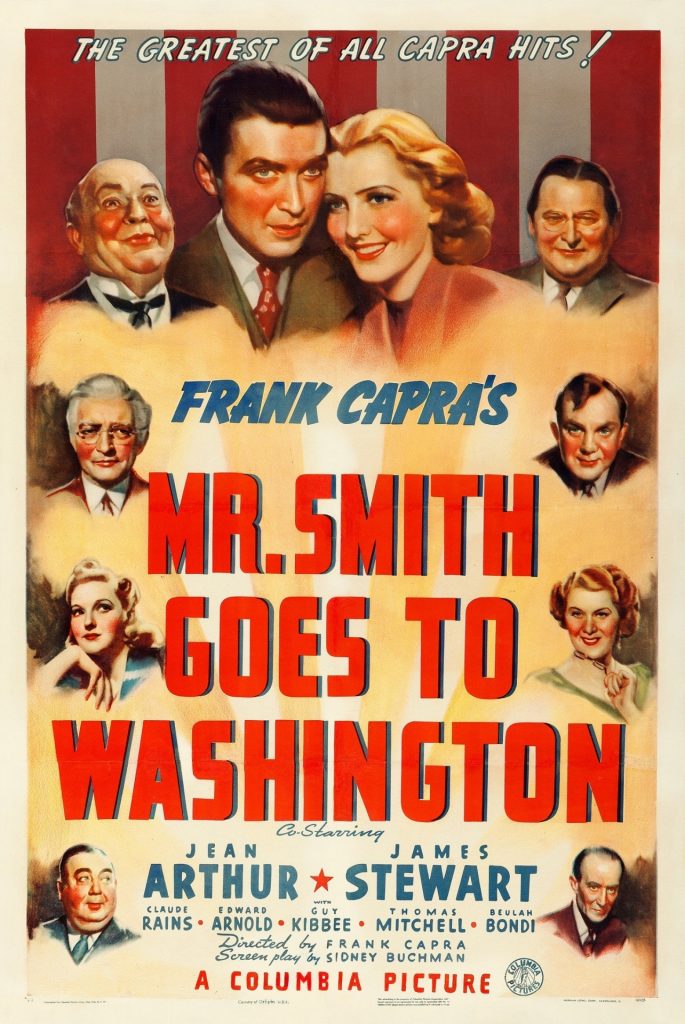
Tomorrow, Monday, October 7th. Frank Capra and James Stewart’s Mr. Smith Goes to Washington will play at the Cinema Arts Centre on Park Ave in Huntington. The Cinema Arts Centre regularly shows both new and old films, as well as other events. It is a valuable location with seats, drinks and films you can’t get anywhere else and a must visit for all on Long Island who love America’s unbelievable cinematic history.
If you’re going into this movie totally unaware and looking to be enrapt by every scene, read no further. Just go, experience it for yourself, and then come back to talk about it. If you agree that even knowing the whole plot and its conclusion does nothing to spoil this cinematic masterpiece of an appeal to the human spirit, carry on…
What: Mr. Smith Goes to Washington
When: Monday, 10/7 @7pm
Where: The Cinema Arts Centre, 423 Park Ave, Huntington
Guest Speakers: Rep. Steve Israel, Rep. Peter King, &
Michael Nathanson, film executive and former head of MGM
Near the end of Mr. Smith Goes to Washington’s most famous scene — Jefferson Smith’s filibuster — he stands in front of the senate with absolute exhaustion on his face. Hair wet with earned sweat. Eyes glossy from hours of exertion. His tie once excitedly tied neat by a man certain this very chamber was filled with great men, now loose and out of place.
A man born into the senate from youthful hope, Smith now looks ready to die from it a victim of mature corruption. A century later, we still wince at the party forces that damage our politics and read long profiles of men like the ones diluting Frank Capra’s version of Washington. However, the legacy of Mr. Smith Goes to Washington, and Capra’s other lasting pictures, is the alluring and stubborn desire for good his leading men portrayed. A desire for good so earnestly projected, it stands unreplicable.
The earnestness radiating from Capra’s work has lasted a century. I guarantee it will last another. His films live forever because they hold within them never-ending human truths.
The past can feel so distant, the technology and subtle ways of doing things seem alien.
In Capra’s 1934 romantic comedy It Happened One Night, the price of a telegram exceeds the price of a hotel room, and the modern ear cannot tell whether the telegram was expensive, or the hotel was cheap. (The telegram was comically expensive) Details like those can feel from a distant world. Yet, Capra’s films feel modern and contain importance to those living in the 21st century because the humans populating the picture are the same humans populating modern life. We share wants, faults, love, pain. In the case of Mr. Smith Goes to Washington we share a desire for our politics to be fair to every man, woman and child; to live up to its promise to become “a more perfect union,” and a frustration with the corruption that ever threatens to rot every human endeavor. Within It Happened One Night, looking out a rainy window, Clarke Gable spoke
“If I could ever meet the right sort of girl. Somebody that’s real. Somebody that’s alive. They don’t come that way anymore. Have I ever thought about it? I’ve even been sucker enough to make plans…
I saw an island in the Pacific once. Never been able to forget it. That’s where I’d like to take her. She’d have to be the sort of a girl… who’d jump in the surf with me and love it as much as I did. Nights when you, the moon and the water all become one.
You feel you’re part of something big and marvelous. That’s the only place to live. The stars are so close overhead you feel you could reach up and stir them around. I’ve been thinking about it. Boy, if I could ever find a girl who was hungry for those things.”
Within the same film, where the simple act of communicating with a work superior can feel so outdated, Gable’s soliloquy occurring only minutes later is just about the most human moment the genre has ever produced. Who hasn’t dreamed of love? Who hasn’t looked to the past as a time when people were more alive or visited a distant location and imagined a life there? Gable’s thoughts are universal. Whether it be 1934 or 2024 or 1776, people are the same and throughout every moment in the United States’ history we have wanted exactly what Jefferson Smith went to Washington expecting to see.
We want idealistic Americans to tell us the truth and campaign on ideas they believe in. We want votes to be cast based on the ideas presented and we want bills crafted with the lives of every small American citizen in mind. We want liberty prioritized and justice delivered unless it imposes itself on our natural rights of Life, Liberty, and well-earned space to call our own.
The film reminds us that our exhausted, jaded frustration is not new. From the start Mr. Smith Goes to Washington frames these ideals as childish. Every child in the film feels the same as Jefferson Smith, and every adult looks at Smith as a naive man destined to be let down. Smith himself might as well be a child. He spends his free hours helping the local children; his first policy proposal hopes to give them a summer camp. Capra and Stewart most certainly feel as the children do. The cynical men were once children too, and the film comes with an assumption the men once felt as the children do now. It is the world, they hypothesize, that transformed them.
On the train ride to Washington the senior senator, Joseph Paine, remembers Jeff’s father, who fought for the common man against a greed-obsessed mining syndicate. He smiles as he considers the man’s courage, his resolve to fight an unwinnable war. Then, his face changes as he remembers Jeff’s father, slumped over his desk, hat still on his head, with a bullet in his back. We get a sense the shooting had an impact on Paine. That was the moment he realized fighting the system was an unwinnable battle. As Smith finds himself in a similar position later in the film, he knows his war is unwinnable. From the start of the film, Smith knows his father’s story, still, he goes to Washington hoping to find some good. Once the press attacks him, he keeps looking for good. Once he’s told his summer camp would most likely never see the light of day, he spends all night writing it up anyways. Finally, when his fate seems complete and he knows anyone with a conscience isn’t welcome near the senate, he fights.
In this sequence of events Frank Capra makes his philosophy clear: The only way to win is to fight… even when the fight seems unwinnable. The only way good will come into the world is if we refuse to dwell on the bad. It is preaching the good. Preaching the good without any guilt or self-guessing. Willing the good into existence with every atom in one’s being just as Jefferson Smith did throughout his famous filibuster, exhaustion filling his face.
Capra presents his ideas as sincerely as any storyteller has ever dared. There is no sarcasm or self-conscious fear of what others might think. To a jaded soul, he could come off as mushy or sappy. I believe viewing him this way deprives someone of the most honest and earnest filmmaker the American Cinema has ever produced. Capra’s films contain real love, real laughter; they are a place where wealth can be used for philanthropy and lives can be dedicated selflessly. They inspire us to do the right thing even when it doesn’t seem worth it because it is always worth it. He is salve for the soul; a rallying cry to carry on despite all odds.
Again, at the risk of a spoiler, Capra’s masterpiece, It’s a Wonderful Life encapsulates this perfectly. Frank Bailey doesn’t win at the end of the film. He’s in the same spot he has always been in. Mr. Potter is richer than before. The local building and loan is still in deep danger of failure. None of his dreams have come true… they never will. Yet, Frank Bailey’s existence is proven not to be in vain. He does have reason to live. Every day Bailey wakes up, he can look himself in the mirror and know he’s a good man. Every night he knows his children will have a father figure they can believe in. When he walks the street, the people around him respect him not out of fear but out of love.
That is what Frank Capra wants people to envy, the feeling Frank Bailey and Jefferson Smith have when they look in the mirror.
