

A Memorable Prelude
With Howard Hawks’ Bringing Up Baby three things jump to mind
- The leopard. Who can forget a leopard?
- Katharine Hepburn’s line delivery, and
- Cary Grant’s cockamamie physical comedy.
Hepburn’s physical performance shouldn’t be ignored. She communicates power, independence, and some twisted form of confidence. All needed for the effectiveness of her surroundings, but Grant’s athletic communication is the memorable core of the film. His arms up and down, jumping like a little girl and prat falling once a minute. A calm dinosaur scientist pre-leopard, rarely on 2 feet post-leopard. The ridiculousness of every situation Katharine Hepburn casually conjures becomes a physical exasperation from Grant.
Pure memory of Bringing Up Baby has entertained me for an entire commute. Hepburn eventually found a home in 9 pictures with Spencer Tracy. Tracy can give a remarkable reaction shot to Hepburn’s nonsense, but nothing anyone ever provided her can reach the populist bombastic-ness of Bringing up Baby.

Kicking It Up A Notch. Or Four.
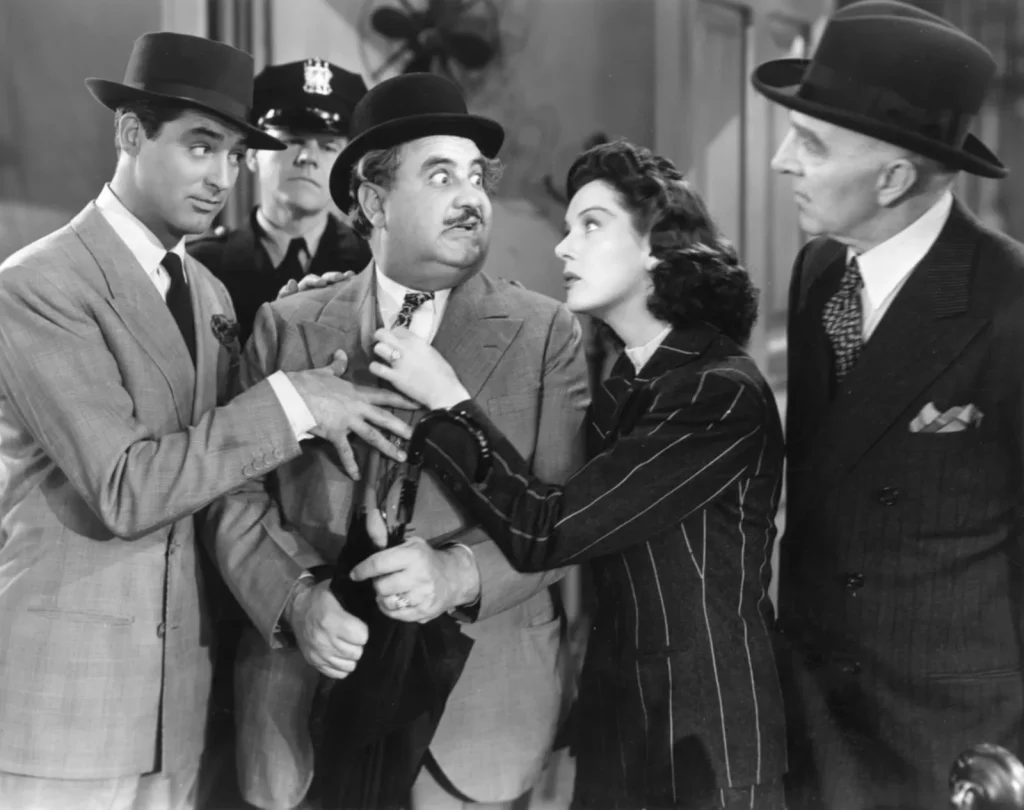
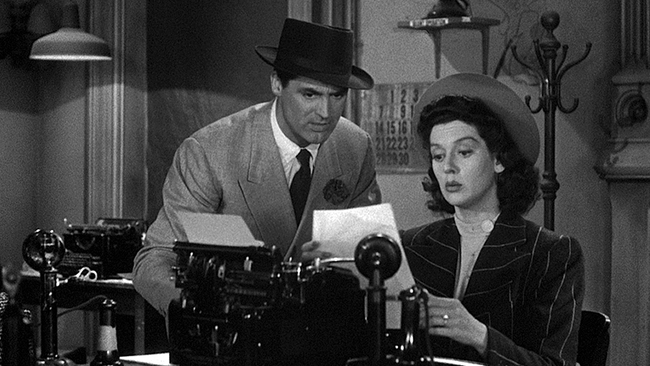
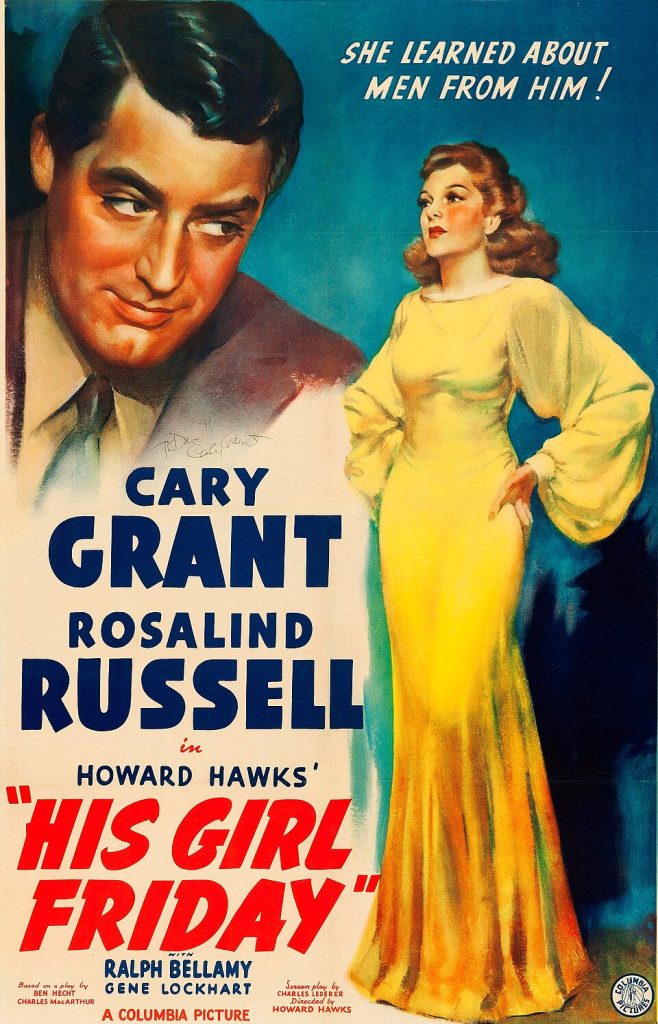
Moving on to His Girl Friday, what happens when Hawks takes Cary Grant’s physical style and molds it into the fastest talking picture ever produced? An in-real-time-self-retrospective comedy. This is a made up term. It’s not a good way of explaining what I’m going for, but an elaboration should get me there.
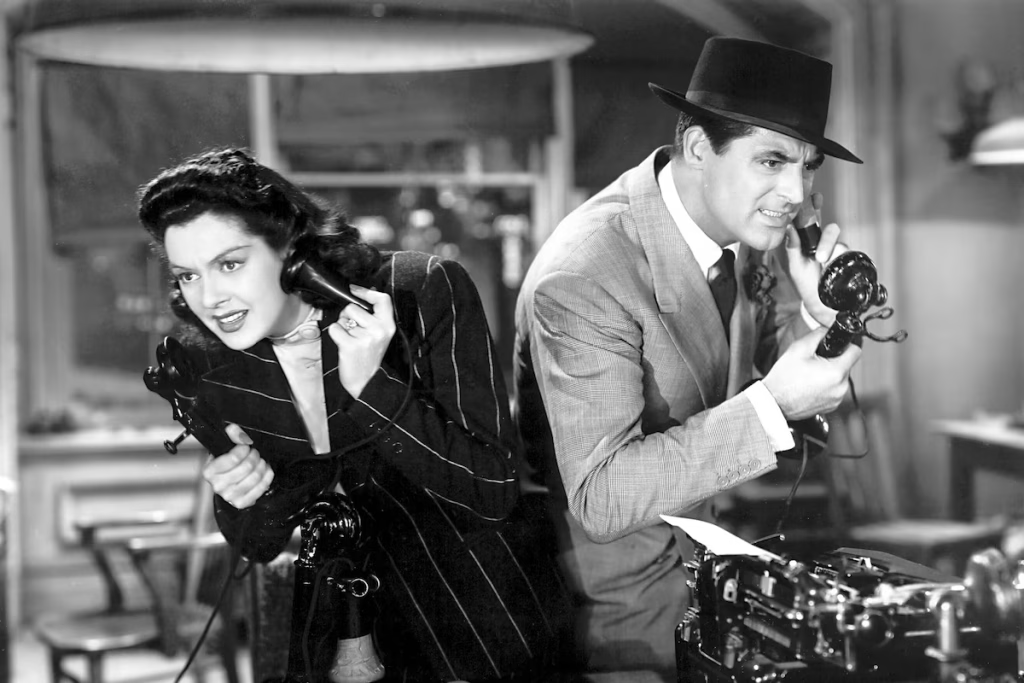
The characters within His Girl Friday talk at a never reproduced pace. Typical film dialogue moves at ~90 words per minute, while Hawks’ masterpiece moves at ~240 words per minute and peaks in multiple scenes at over 300. The speed of conversation in David Fincher’s The Social Network has been mythologized: A movie made by stopwatch… clocking in at under 151 words per minute.
Hawks is moving twice as fast.
So, where’s the space for Cary Grant? There’s space everywhere for Cary Grant, stuffed into every crevice he can find. With all this action, His Girl Friday’s content exceeds the attention capacity of its viewers. The lines are dense in world building, communicating the political climate of this unnamed city (Philadelphia I think), the racial aspects of re-election campaigns, the details of each paper’s political leanings and all the rest that goes into the complex hanging to be done by 6:00.
You could ignore all the context: Everyone on screen sucks. They all have an angle. No one is looking out for the public. Elections, hangings, deadlines, and bribes are all done for selfish reasons. The love within the picture might as well be a hanging or a bribe: It’s all a sociopathic game.
None of that really matters beyond the general vibe of the picture, but the context is too interesting and subtly funny to ignore. Without ignorance, there is simply too much information and stimulus being thrown at the viewer. Only a 1940s newspaper man could think that fast. Cary Grant’s physical comedy only adds to the texture of overload.
At The Very Least Three Steps Ahead
Here’s the magic, the order of things viewers must pay attention to:
- Cary Grant. He’s too charismatic not to be first. It’s human nature.
- The context and story.
- The spoken comedy.
The vocal bonanza comes third, and yet His Girl Friday might have the studio system’s funniest screenplay. At the speed with which it works, by the time you comprehend the brilliant lines Rosalind Russell delivers, the film is three steps ahead.
Laughter at one line emerges from your consciousness 70 lines later. In this way, one watches His Girl Friday 15 seconds behind the light entering your eyes.
Even better, the late comprehension compounds with the in-real-time comprehension in layers. Cary Grant, contorting his body to avoid a finger pointed at him. Laughter. The ridiculous political situation that unfolds while Cary Grant is pretending no one pointed at him. Laughter. Then you comprehend the line said before the finger was pointed. More laughter.
We’re laughing at the right details, just not in the order presented.
Wait, What Are We Watching?
The bones of the story go like this: Walter Burns (Cary Grant) runs the Morning Post. His top reporter and ex-wife, Hildy Johnson (Rosalind Russell), returns to town with Bruce (Ralph Ballamy), a new fiance. He’s a sweet man. Not a fast talking, amoral, newspaper man.
Bruce is your friendly small dog. Walter Burns is a coyote deep in the thick of things.
A local man is to be hanged and Walter attempts to pull Hildy back into the action by luring her into writing a pre-execution interview. Walter needs her: The man killed a cop. His execution is a good headline for the mayor. No execution, mayor loses on election day. The Democratic newspaper needs the mayor gone, and Walter needs Hildy to relapse into the news business. Only a woman’s hand could write these words. Imagine what a star she will be!
He hopes her relapse will be as good as done once she feels the rush of the mud…
Try to Keep Up, Bruce
To this rapid picture, the presence of Bruce could be a problem. The suburban slow-talking fiance could slow down the picture.
His Girl Friday cannot slow down. It’s not in its nature. It breathes, it dies. Hawks get around his presence by having Bruce communicate through a phone a lot of time. Other times he works within the collage of a filled room. That works, kind of, but for a central character he needs to be in frame at some point. Therefore, the picture needs Cary Grant.
Someone needs to keep the energy going when a man not of newspaper filth is speaking. Grant moves his face, chest, and the rest to fill the 30 seconds before the next interruption. We need someone to grab the screen and hold our attention. With anyone else, the pace slows and the movie becomes uneven.
Bruce can plod. We’re panting and processing. It’s hysterical.
Did I Say You Can Ignore the Context?
I said you can ignore the context. And you can. But you can’t.
This film is ahead of its time, an indictment of its present, and a tale as old as Zeus and Hera that moves with the manic frenzy of Superbowl halftime show. Its madcap intrigue of a love story, which itself takes three watches to begin to comprehend, is overtaken only by the way Rosalind Russel steals her own show, heralding a feminism that will soon be forced to the fore then buried like a bad bad dream before coming into its own in a performance that may have at first made Gloria Steinem shine, and then perhaps cry.
There’s a whole essay on that before we can even begin to deconstruct the multifaceted, whirlwind of a backdrop. There is politics. There is intrigue. There are windows to jump through. Desks to rifle. A fascinating glimpse of history and human nature that only seems to get more profound when viewed through a thoughtful modern eye.
Stay tuned…
