Adventures of Craig & Trudy in Community Leadership, Chapter 2: Touching on Temperament.

Some notes on a few of the temperament styles. Photo by Trudy Fitzsimmons

What would you do with an extra $300? Pat and Craig Rider used it to make a dream come true. During their honeymoon on a sailboat they discussed starting a business. Within a year they had established a consulting company with $300 bucks Craig earned teaching an extra college course. The Riders’ personal and professional journey now spans more than three decades.
Craig and Pat Rider are co-founders of The Rider Group, Inc. which specializes in team building, leadership development and retreat facilitation for organizations throughout North America. Their work with city, county and state-wide community leadership programs has earned state and international awards of excellence.  

Craig holds an MS in Counseling and Guidance and a BA in Psychology. Pat has a BS in Political Science. Active community advocates, both have chaired major fundraisers. Pat’s extensive volunteer work earned her recognition as a YWCA Woman of Influence and as one of Dayton’s Top Ten Women. What a dynamic duo. The preceding excerpt was taken from the book they wrote entitled “300 bucks and a dream,” which you can purchase online. Permission was given.

Thank you Craig. 

Remembering Where we Started

“We see the world, not as it is, but as we are.”   ~ The Talmud

By 2014, both the Rider Group and I had been involved in Huntington’s Leadership program for almost 20 years. I thought the history should be told, or at least recorded somewhere. In my desire to capture the history of Leadership Huntington, I arranged a dinner to include Ken Christensen, Libby Hubbard, Dianne Parker, Lou Giordano, Craig Rider, Kate Laible and myself.
During the course of the dinner Ken piped up saying “This needs to be on the record.” So this story goes: 

Craig was hired to conduct the first class retreat for Leadership Huntington in 1994. Everyone was nervous and wanted to make sure the retreat would go smoothly. Ken, feeling responsible for the program asked Craig, “What are you going to do?” 

Craig replied, “Stuff.”

Ken immediately became concerned and exclaimed “STUFF!?!” He then said, “I am not a stuff guy. I don’t do stuff! I want to know what you are going to do in detail. I am not going to trust you to do ‘STUFF.’”

Craig calmly replied, “As I evaluate the class and see what they are doing I will adapt. I need to know who the class is, what their collective personality is and their situation. I will accommodate whatever it is they are doing.” 

Ken said that didn’t make him feel much better but he did go to all the retreats because, “Craig’s STUFF WAS GOOD STUFF!”

At those retreats, Ken learned that he is a Beaver. To understand what that means, keep reading.

The Chairman of Leadership Huntington, the unflappable Lou Giordano also spent time speaking with Craig at the retreat. Craig commented “I don’t know if you knew I was a native, but it means so much to be in my hometown working with Leadership”

Lou replied, “Don’t you think I checked your references?” 

Craig replies, “You mean my Aunt Neeta and Cousin John?” 

Lou’s eyes opened wide. That was a gotcha moment. Craig has a keen sense of humor and, fortunately, so does Lou. 

Lou is an Owl. If you have been through the program with either of them you may get the humor of the situation. 

The main purpose to these little pieces of information is to introduce you to some examples of Temperament. When Craig evaluated the class, he used an instrument called the “Myers- Briggs” assessment tool.* Later, he replaced this with something he felt was simpler for folks to understand, called “Temperament.”    

Temperament

“Temperament identifies the basic needs and core values that drive our behavior and our choices. It is an interdependent, self-supporting system”     ~Linda Berens

The class would take the assessment to bring them to an understanding of how different each of us is, and what our learning styles are according to the Temperament Summary. I will share just the basics with you.**

Understanding temperament patterns is a crucial part of developing key leadership skills. Having an awareness of why and how you and others communicate and perceive information opens the door to more effective relationships and productivity.
 

During the retreats, Craig would offer many exercises — “STUFF” — to help understand how all this works. The following short descriptions, while not complete, provide an initial understanding of the patterns of behaviors, values, talents and needs. We are each a mix of temperament types, typically with one type as our preferred, or dominant type. Temperament is a language of how we are wired; the “deck of cards” we have been dealt.

Basic Characteristics of the 4 Temperaments:

“No one temperament can be said to be better than another. Each one contains strengths and richness, yet each one is fraught with its own weakness and dangers.”  ~ Tim LayHaye

The Beaver values being part of a group; having membership. Beavers are the cornerstone of society, establishing and maintaining standard operating procedures. They tend to protect, serve, stand guard and warn. Looking to the past and tradition, they may focus on the conventional. They pride themselves on being dependable and hardworking. They are generally serious, concerned and often fatalistic. Often they are skilled at getting everything in the right place- information, people and objects. 

Time Orientation: Past 

For those familiar with Meyers-Briggs, Beavers fall under ESTJ ISTJ ESFJ ISFJ

The Owl exhibits knowledge and competency. As the problem solvers, they tend to focus on complex systems of the world. They analyze how something works and then how to make it better. Seeing everything as conditional and relative, they trust logic and reason. Driven to accomplish their goals, they work tirelessly to complete projects. They are often fiercely independent leading some to think they are cold or distant. However, they are more likely simply immersed in the problems they are currently solving. 

Time Orientation: Infinite 

Meyers-Briggs Profiles: ENTJ, INTJ, ENTP, INTP

The Dolphin tends to be authentic, kind and empathetic. This is the self-improvement temperament. As a visionary and idealist, the Dolphin wants to make the world a better place, searching for identity, meaning and significance. They focus on similarities as a way to find integration. In whatever field they are in, they work well with people and groups of people. Their drive for self-knowledge, along with their general loving demeanor is inspiring to those around them.  

Time Orientation: Future

Associated Meyers-Briggs profiles: ENFJ INFJ ENFP INFP 

The Fox has an innate ability to excel in the art of their choice, whether it is business, athletics, military, or industrial. They trust their impulses, and seek to have an impact and get results. They are optimistic yet realistic, unconventional yet focused on the here and now, often getting absorbed in the action of the moment. They want freedom to move, seeking adventure and stimulation, and seizing opportunities that come to them. They will often take the road others feel is too risky, doing whatever it takes rules or no rules. 

Time Orientation: Present

Associated Meyers-Briggs Profiles: ESTP ISTP ESFP ISFP

* Myers–Briggs typology as categorized by David Keirsey. This document is a summary of the four temperaments based upon the following sources: Berens, Linda V.,”Understanding Yourself and Others: An Introduction 4.0” Radiance House, West Hollywood, Ca., 2010; Keirsey, David, Please Understand  Me II, Temperament Character Intelligence, Prometheus Book Company, Del Mar, CA, 1998.

** Please understand Myers-Briggs is a complicated instrument. It is not intended in this short writing to evaluate anyone, only to produce an awareness and understanding that people have many ways of processing information.     

Next month:  Leadership and Community Trusteeship

Local John C. Maxwell Partner Supports Leadership Through Crisis

Image Provided by Deb Ingino

We are leadership and personal development geeks. We love steeping ourselves in folks who value service and who rally the world to give it their best to put their best foot forward.

One such soul is John C. Maxwell. He’s basically a preacher who found his true higher calling as a secular Leadership Development guru. Having followed him on some level since 2008, we find his definition of leadership as influence and of a leader’s purpose as being to serve others, as well as his knack for asking excellent questions deeply fortifying.

Last week, John hosted a series of Livestreams called “Leading Through Crisis: Virtual Leadership Summit”

He also offers daily inspirations; A Minute with Maxwell.

It’s kind of like a “Church of Leadership as Service,” He’s humbling, inspirational and a good storyteller. It helps.

From the Global Message to Local Support…

Honestly, though, we wouldn’t have realized those events were happening if it weren’t for our friend, John C. Maxwell partner, Deb Ingino. Deb didn’t introduce us to Maxwell, and honestly we’ve learned more from her deep experience independent of that affiliation, but we knew we’d found a kindred spirit the first time she mentioned his name.

Deb is now offering her own mastermind session:

Long Island Leading Through Crisis – An Online Leadership Roundtable

We hope you can join Deb Ingino and other business leaders as we learn to become better leaders together and face the challenges of today,

When: 4-5:30pm Monday April 6th through Thursday April 9th

To Register: Go to the Eventbrite Page

This is not a selling event for Deb, this is a serving event from her to the Long Island community. Therefore there is no cost and it is considered a “private” event. Please register so she can email you the online connection link, the phone number access option and your participant guide.

The Adventures of Craig & Trudy Chapter 1: Community Leadership, How We Got Here

Photo of Trudy & Craig

My name is Trudy Fitzsimmons and, as Kate Laible said, “Craig Rider and I are up to something,”

So, here we will give a little history of Leadership Huntington and what it has meant to us and the community as we experienced it.  Craig and I have not been directly involved with the Leadership Huntington program for a number of years, but have fond memories of our time contributing to the program. We would love to share the experiences, including some firsthand stories recounted as we remember them.

Sit back and relax because this may take a while.

In the late 80’s early 1990’s, the Huntington Township Chamber of Commerce started to develop a Leadership program because several of the board members had been to multiple meetings that week and had started to remark to each other, ”Who will follow in our footsteps when we are no longer available?”

The Chamber developed a not-for-profit arm, “The Huntington Chamber Foundation,” with the help of board member Ken Christiansen and Dianne Parker, who had been hired as its Executive Director. Together with other community leaders, they developed a number of programs. One, was a community leadership program that was designed to produce well informed, motivated leaders who are willing and capable of working together for the good of the community. The Chamber Foundation had, early in its development, over 100 volunteers contributing their talents to creating this leadership program. Ken, who was deeply impressed by how much even a person like him who had been deeply involved in the community learned through the process, often remarked that this group was “in many ways, really, the actual first class of Leadership Huntington.”

This is where Craig Rider gets involved. Craig grew up in Huntington. In an effort to stay in touch with his home town, he had continued to subscribe to The Long Islander. There he read about the Foundation starting a leadership program and called to offer any assistance he could. Being a master facilitator, he had developed a leadership program in Dayton Ohio and worked with many companies all across the United States. We’ll tell you more about Craig’s education and experience later.

So let me continue……

What is Leadership Huntington you ask? Well, I will tell you.  It is an experiential program that later became its own independent 501C3. It has turned out about 15 to 20 graduates per year for the last 20 + years, giving these folks a 360 degree view of the 100 square miles of the Township of Huntington. Leadership serves those open to learning about getting involved in our town and across Long Island as trustees and servant leaders. They believe this program is a best practice for community leadership on Long Island and in the country. It is the only program of its kind on Long Island and one of nearly 1000 across the nation.

Yes, there are other leadership programs offered by universities and such but none that are strictly local or experiential. We believe every Town should have a leadership program to help educate the willing. Leadership builds networks of people who develop skills and learn how their communities work, while providing them with tools to plan a future of their own. One of the things that makes this experience unique is the diversity of the participants. It includes people from business, government, not for profits, arts, science, medical and energy sectors. The young, old, women, men…whoever has an interest.

A number of local businesses, corporations, not for profits, and local government offices have used Leadership as a teaching tool for their employees. For me, over the last 20+ years it has been a privilege to meet some of the most dynamic, talented and generous people who, each in their own way, continue the good work. We will share some of their stories as we go.

Feed Your Soul

Photo by Jamie Street on Unsplash

While we STRONGLY RECOMMEND erring on the side of science in terms of understanding how disease spreads and what we have good evidence heals, we also know a great many who (while also following Dr’s orders) find healing and overcoming a deeply personal experience that is greatly strengthened by their faith.

We have also long agreed with Dale Carnegie that prayer is much more psychologically useful than worry and — when there’s nothing else we can do — remains better than doing nothing.

Many houses of worship are closing. While we haven’t yet found a comprehensive guide to what’s now available, we have seen many of our faithful friends posting information about services that are occurring online. We encourage you to contact your own community. We will share what we come across.

We see that Donna Martini has been offering her own “Mighy Mantras” on Facebook as her contribution to helping folks find some spiritual solace.

Additionally this local “Moonful Mama” has been offering some global healing meditations as well as a little of her own Momma’s spirit regarding how we might all find opportunity in times of crisis.

While she probably wouldn’t call herself a faith healer, we do find Maria Popova’s Brain Pickings deeply soothing to our souls. Here is her Meditation on Thich Nhat Hanh’s, “How To Love” a lesson on how to grow our hearts.

For our own part, we pray that – now and always – humanity endeavors toward truth and love, best we may humbly discern our way forward, fueled by faith, dexterity and strength, with gratitude for every blessing we may count, especially to those who keep hope alive.

Peace and well-wishes to all.

Networking Can and Should Continue!

Photo of Robbie Samuels, Zoom Facilitation Expert and Relationship-Based Business Strategist, Provided by Robbie Samuels

Photo provided by Robbie Samuels

We thought this article from our friend Robbie Samuels was really helpful:

9 Ways to Network During a Pandemic

“Due to an abundance of caution, we’re canceling our event.”

All over the world, event organizers have had to make the difficult decision to send this message.

According to the International Association of Exhibitions and Events, 76% of people surveyed said that networking was a top driver for why they chose to attend a live event.

How do we keep networking if live events are being canceled, postponed, or becoming virtual events?”

Read Robbie’s Suggestions here

Online Virtual Meeting Tools

We’ve also been thinking about how to meet remotely, and what services might be helpful. Our friend, Deb Ingino brought Zoom to our attention, which was also recently recommended by a dear friend Kathy Kuthy.

Thanks to Pilar Moya, we learned that Google is making their premium version of Hangouts Meet free until July 1st. She also led us to be reminded about Skype Meanwhile, our kids have having a lot of their own meetings on Facebook Messenger.

Of course, the phone still works, too. 🙂

The Philosophy That Guides Us

We’ve been reflecting quite a bit as we endeavor to develop this communications platform centered on our Synchronicity Network Newsletter. Our mission, as currently understood, is this:

“The mission of Synchronicity Planning & Communications is to serve and celebrate folks who care for art, science and the common good, improving the quantity and quality of community engagement on Long Island via a networking and communications platform centered on the Synchronicity Network and its Flagship Newsletter.”

Digging deeper, we ask ourselves WHY? For her part, Katie has offered the following:

Continue reading

On Sunflower’s Golden Spirals

Photo credit: Esdras Calderan/wikipedia (CC BY 2.0) https://commons.wikimedia.org/wiki/File:Espiral_de_semillas_de_Girasol.jpg
 
I’d like to talk about patterns. In particular, the pattern that you might see if you look at the sunflower above.*
(Photo credit: Esdras Calderan/wikipedia (CC BY 2.0) https://commons.wikimedia.org/wiki/File:Espiral_de_semillas_de_Girasol.jpg 

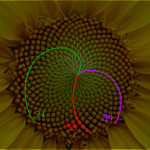
Before you even think about it, I’m sure you can see spirals. Maybe you see them whirling clockwise, maybe counter-clockwise. Let your eyes refocus and another set of spirals will appear. They almost seem to pop out in your vision, but hang on; which is it? Are they going left or are they going right?

We have an incredible talent for picking out patterns out of noise; you can recognize a friend in a crowd or a familiar song over construction noises without thinking about it. Our sense for patterns is so sharp that we see faces in the moon or in potato chips, or shapes in the clouds. This is probably for the better; thinking you saw some food, some hidden danger, or even a friend where there is none is a lot safer than missing the one that actually is there, so I’d definitely take some silly crossed signals in exchange for this power of ours.

These are harmless examples, but there is a dark side. Gamblers see patterns in their wins and losses and make catastrophic bets. Con-artists exploit us, claiming to tell the future or read minds. Confirmation bias is a dangerous habit that has pervaded our political discourse, where we pick out evidence and patterns in data that suit our preferred answer. We don’t do this with ill-intent; it’s something our patterned-tuned brains do beyond our control. We can only fight it if we watch ourselves, think twice, and double check the news we forward it to our friends.

We also see patterns on another level; we find curious connections throughout the world, linking ideas that don’t seem related. Sometimes it looks like magic, others like design. Sometimes, it’s our minds searching for something that’s not there. As a scientist, this can be frustrating for me. I see articles about psychic powers and fake science, dangerous alternative medicine, and this prevailing tendency to make science mystical and unknowable. I think many people would be surprised as to how much they can understand with a little patience. We don’t need to scrutinize every detail in our experience, but I don’t like it when people assume that that is beyond them. Sometimes, with some care, the microscope lets us peel back the veil of nature and find the truth behind a pattern.

Photo credit: Max Ronnersjö/wikipedia (CC-BY-SA-3.0) https://commons.wikimedia.org/wiki/File:Aeonium_tabuliforme.jpg
The Fibonacci sequence and the Golden Ratio are patterns that pop up all the time in nature and in media. The Fibonacci sequence follows a simple rule; I start with the first two numbers, 1 and 1. If I add these numbers I get 2. If I add the 2nd and 3rd numbers (1 and 2) I get three. Add the 3rd and 4th I get 5, etc. The sequence looks like , etc. It sounds like the kind of thing a bored mathematician would do for fun, but it has a peculiar habit of showing up all over nature. Plants seem especially fond of it; you can see it in the arrangement of leaves on a stem, the scales of pineapples, and as it happens, the florets of a sunflower. If you go back to that first picture of a sunflower and counted the spirals in the seeds, you’d notice something interesting. I can pick out spirals at a bunch of different angles and directions, but the number is always a Fibonacci number.
 
Photo credit: Esdras Calderan/wikipedia (CC BY 2.0) Fibonacci Spirals added by Spencer Thomas
 

This is a peculiar quirk of the way these florets grow. The plant spirals out as it produces them, following a rule – each seed is some angle from the last. This angle happens to be a full  divided by , where  (the Greek letter ‘phi’) is the Golden Ratio, about equal to 1.618.

Like the Fibonacci sequence, the golden ratio appears everywhere in nature. People have known about this number for a very long time; the ancient Greek sculptor Phidias (400s BCE) worked it into much of his art. A quick google search will tell you how people have associated it with the ratios of beautiful faces, sections in pieces of music, etc. The ratio itself also has some neat properties, for example  (in fact  is sometimes likened to ’s little brother).

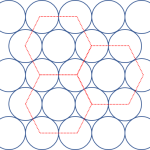
So what does  have to do with Fibonacci number? The two are intimately related. If I divide the 1st and 2nd Fibonacci numbers (1 and 1), I get 1. The 2nd and 3rd (1 and 2) give me 2, the 3rd and 4th give me 1.5, then 1.666…, then 1.6, etc. If I keep picking later and later Fibonacci numbers, I get closer and closer to . That’s that mystery solved, but why does a sunflower care? Sunflowers probably don’t know math, but they’re also not stupid. They’re carefully optimized by evolution to make the most out of what they’ve got; their mission is to fit as many seeds as possible onto their face. As a material scientist, I could tell you the very best way to do that looks like this:

Diagram provided by Spencer Thomas
 

It looks a lot like a honeycomb and that is no mistake. This is how bees achieve the same goal, but the sunflower kinda wrote itself into a corner. The spiraling mechanism that sunflowers use to grow can’t make a honeycomb; it’s terrible at making packed arrangements, always leaving some empty space. Instead of completely altering how the sunflower grows to solve this problem, evolution tuned it to do the very best with what it has, and  with its Fibonacci spirals happens to be the optimal turning angle.

It was shown by J.N. Ridley**  that this is the best possible way to pack seeds on a sunflower’s disc and this video is a beautiful demonstration of the idea. What it comes down to is that  is almost 21/34, and it’s almost 34/55, and almost almost 55/81, but these are all really bad estimates. By comparison, 22/7 is a pretty good estimate for Pi. You need really large numbers to get a ratio that’s close to, so a turning angle of  is a sunflower’s best hope at making the messiest spirals it can.

Give yourself some credit; that sunflower is doing everything it can to hide its spirals, but you can still see them clear as day!

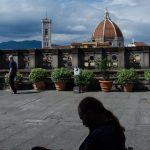
Dr. Spencer Thomas, atop the Uffizi in Florence, Italy.

Spencer Thomas recently received his PhD in Materials Science and Engineering from the University of Pennsylvania. He is now doing his Postdoc at North Carolina State University in Raleigh. He also happens to be Katie’s brother. Spencer studies metals at the atomic level; the way atoms are arranged in a material can change its properties; one can take ordinary metals make them stronger, more flexible, corrosion resistant, even radiation resistant.

Spencer believes that no matter who you are, good communication can put scientific concepts within reach. The modern world demands scientific literacy and it is the responsibility of scientists to make that possible.


Pal-O-Mine Equestrian: Harnessing the Healing Power of Horses

The overwhelming sense we had when visiting Pal-O-Mine Equestrian was peace. Peace, love and deep, deep commitment to serving the folks of diverse needs who come to learn and receive therapy. They say the word “miracle” comes up a lot here. We’re not surprised.

Continue reading

Guest Post by Jed Morey: We’re Not Here for Long. Let’s Do Better. Together.

Photo of soaring gull by Katheryn Laible

A couple of days ago I joined the chorus of self-righteous outrage and posted the image of the now infamous MAGA hat wearing kid and Indian activist face-to-face. It’s been years since I posted anything purely political and I rarely, if ever, post something without context. But this image stuck with me. So I posted it without commentary, context or linking it to an article. Just the photo. What ensued on my wall happened all around the country on social media, at dinner tables and on television.

Continue reading

PARTING WAYS doesn’t mean you can’t keep it together

Photo by Nathan McBride on Unsplash

This is the happiest time of the year and ironically one of the times that people are most likely to get divorced. Troubled couples often hope that the holidays will make everything better, and then ultimately when it doesn’t, it’s time to make a change.

Continue reading